
Service Hotline:136-5256-5866 Mr. Wu


Application areas
Rural sewage in villages and towns: decentralized domestic sewage treatment in rural and market towns.
Public facilities: Sewage from scenic spots, homestays, hotels, resorts, schools, and hospitals.
Factory campsites: factory living areas, temporary construction site camps, mines, islands, and service areas with domestic sewage.
Renovation projects: renovation of old small sewage stations, land shortage projects; Treatment of low-concentration partial light industrial wastewater.
Product Introduction:
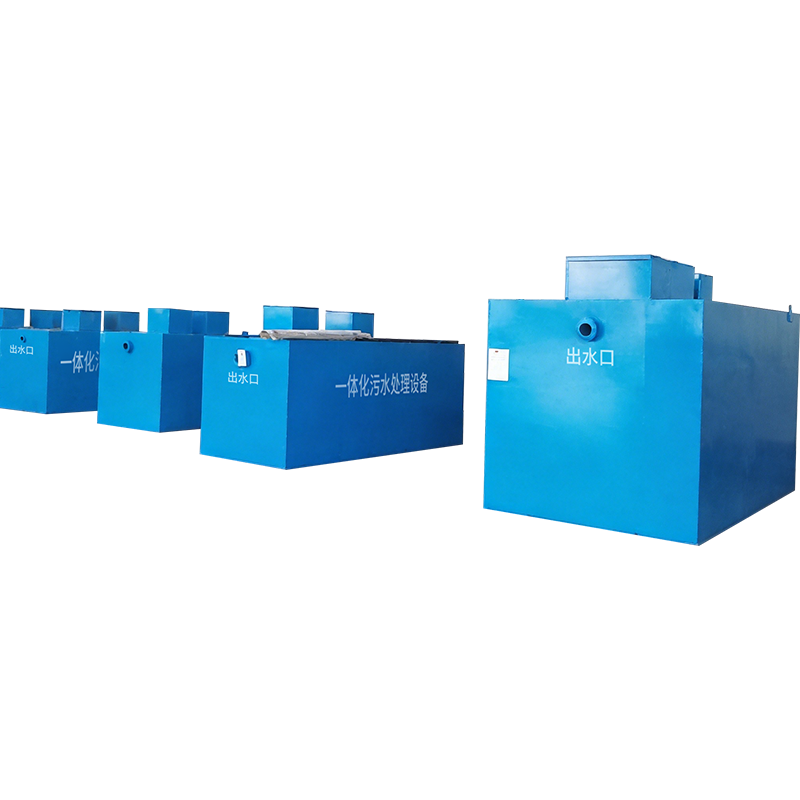
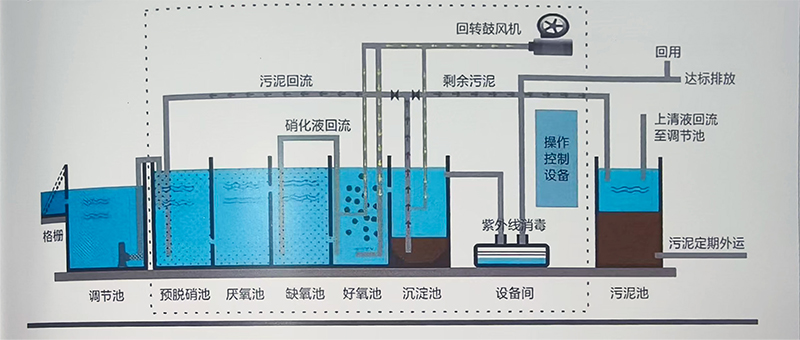
Integrated sewage treatment equipment: sewage first passes through a grid to intercept large debris and enters the regulating tank, balancing water quality and quantity to buffer shock loads. Wastewater enters anoxic tanks for denitrification and total nitrogen removal; Then it enters the aerobic aeration tank, where microorganisms decompose organic matter and degrade ammonia nitrogen; MBR model sewage flows through membrane modules, which trap sludge microorganisms, achieving sludge-water separation and replacing traditional secondary sedimentation tanks. Ordinary contact oxidation type undergoes gravity precipitation; MBR relies on membrane filtration, with clean water drawn out and produced by sludge returning to the biochemical tank, while the remaining sludge is regularly transported for treatment. Clean water is disinfected with ultraviolet light, discharged to meet standards, or reclaimed water is reused. Most processes use A/O/A²/O or MBR membrane bioreactors, integrating grid, regulation, anoxia, aerobic biochemistry, sedimentation, and disinfection into skid-mounted or underground complete machines, prefabricated in factories and installed on-site, saving a large amount of civil engineering tanks. The equipment can be placed underground, semi-subground, or above ground; The upper part of the buried structure can be greened and hardened. Relies on microbial degradation of COD, BOD, ammonia nitrogen, total nitrogen, and total phosphorus; The MBR model replaces the secondary sedimentation tank with membrane modules, ensuring thorough separation of slurry and water, with effluent reaching Class 1A standards, and can be reused for landscaping irrigation; Equipped with PLC fully automatic control, it can automatically aerate, produce water, and clean membranes, requiring no dedicated personnel, suitable for small to medium-scale domestic sewage and some low-concentration production wastewater. Common materials include carbon steel for corrosion resistance, fiberglass, and stainless steel; Treatment capacity: 5-500m³/day.
Performance Features:
Small footprint: Integrated and integrated, fully buried underground, with surface greening as the site. Civil engineering volume is minimal, construction period is short, and production can be put into place after on-site hoisting.
Stable effluent: MBR membranes have excellent solid-liquid separation performance, strong resistance to impact loads, and the effluent can reach Class 1A, suitable for reclaimed water reuse.
Fully automatic operation: PLC automatically controls aeration, suction, membrane backwashing, and fault alarms. Daily maintenance is simple, sludge output is low, and sludge can be removed periodically.
Sealed box: reduces odor leakage; Carbon steel is corrosion-resistant and fiberglass, corrosion-resistant with a long service life; Container-type design is convenient, making it easy to relocate and move.
Application areas
Rural sewage in villages and towns: decentralized domestic sewage treatment in rural and market towns.
Public facilities: Sewage from scenic spots, homestays, hotels, resorts, schools, and hospitals.
Factory campsites: factory living areas, temporary construction site camps, mines, islands, and service areas with domestic sewage.
Renovation projects: renovation of old small sewage stations, land shortage projects; Treatment of low-concentration partial light industrial wastewater.
Process flow:
Design influent and outlet water quality parameters
| Project | Influent Water Quality (Domestic Sewage) | Effluent Grade A standard |
| CODcr | 250~450mg/L | ≤ 50 mg/L |
| BOD₅ | 120~220mg/L | ≤ 10 mg/L |
| SS Suspended Solids | 150~250mg/L | ≤ 10 mg/L |
| NH₃-N ammonia nitrogen | 25~40mg/L | ≤ 5(8)mg/L |
| TP Total Phosphorus | 3~6mg/L | ≤ 0.5 mg/L |
| TN Total nitrogen | 30~50mg/L | ≤ 15 mg/L |