
Service Hotline:136-5256-5866 Mr. Wu


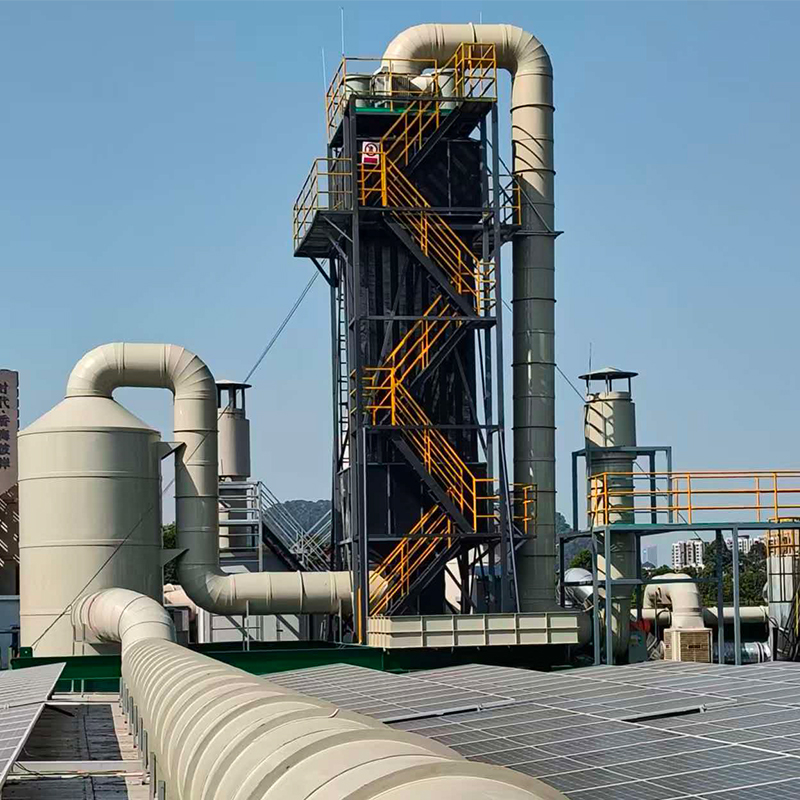
Working principle
1. Charging: The high-voltage direct current (DC) power supply generates corona discharge at the cathode discharge electrode, causing the fine dust and mist droplets in the flue gas to acquire negative charges;
2. Collection: Charged particles migrate towards the anode dust collection electrode (anode tube/plate) and are adsorbed under the influence of Coulomb's force in the electric field;
3. Water film ash removal: Water is sprayed from the top to form a continuous water film on the anode surface, continuously flushing the plates. The dust and smoke flow downwards with the water and are collected in the bottom liquid collection tank for discharge. There is no mechanical vibration, thus eliminating secondary dust emission;
4. Demisting emission: The purified flue gas passes through the demisting component to remove the entrained water droplets and is then discharged after meeting the emission standards.
The core difference from dry electrostatic precipitation lies in the use of water film for ash removal, which is suitable for high-humidity, viscous, and corrosive flue gas.
Main structure (vertical tubular honeycomb type is the most commonly used)
- Shell: carbon steel rubber lining / fiberglass / 316L stainless steel (anti-corrosion option)
- Anode module: honeycomb anode tube (hexagonal)/round tube/flat plate, mainstream honeycomb type, high space utilization
- Cathode system: cathode wire (barbed wire/spiral wire) + insulation box (with heating and anti-creepage function)
- High-voltage power supply: high-frequency high-voltage DC power supply, control cabinet
- Spray rinsing system: spray nozzle, circulating water pipeline
- Airflow uniform distribution device, top demister, and bottom liquid collection and drainage tank
Applicable working conditions
- Flue gas from boilers, kilns, waste incineration, metallurgical hot dip galvanizing, and aluminum melting furnaces (after desulfurization, deep dust removal at the end, and white smoke elimination)
- Chemical industry, coking, asphalt, and carbon black: tar mist, viscous smoke dust, acid mist aerosol
- Spraying, incineration, and acid cleaning exhaust gases: fine particulate matter, heavy metals
Conventional process route: cyclone dust removal → spray scrubber → wet electrostatic dust removal tower → chimney (pre-treatment to remove large particles to protect the wet electrostatic electrodes)
Advantage
1. With a removal efficiency of 95% to 99% for sub-micron fine particles (PM2.5), it can stably achieve ultra-low emissions of particulate matter<5mg/m³;
2. It is not affected by dust specific resistance, and can handle high-humidity, viscous, oily, and acidic flue gas;
3. Low flue gas resistance and stable operational resistance;
4. It can simultaneously remove acid mist, heavy metals, and some aerosols, eliminating white smoke/colored plume;
5. Online water flushing, without stopping the machine for ash removal, ensures no secondary dust emission.
Key parameters for model selection
- Handling air volume, flue gas temperature, and inlet dust concentration;
- Flue gas medium: Determine whether it contains SO₃, HCl, HF, and tar, and select the appropriate shell/electrode material;
- Flue gas velocity: generally 0.8~1.8 m/s for tubular wet electrostatic precipitators;
- Electric field residence time, high-voltage power supply level;
- Quality of flushing water, circulating water + wastewater treatment plan.
Common Faults
- Condensation and creepage on the insulation box, frequent tripping;
- Scaling on the anode tube and ash/coke deposition on the cathode wire prevent the voltage from increasing;
- Uneven spraying, water film interruption, and decreased capture efficiency;
- The shell is damaged due to corrosion, resulting in corrosion leakage.